
Why HR Workflows Break When You Need Another Tool
Written by Repute Network, Jun 4, 2026 · 5 min read
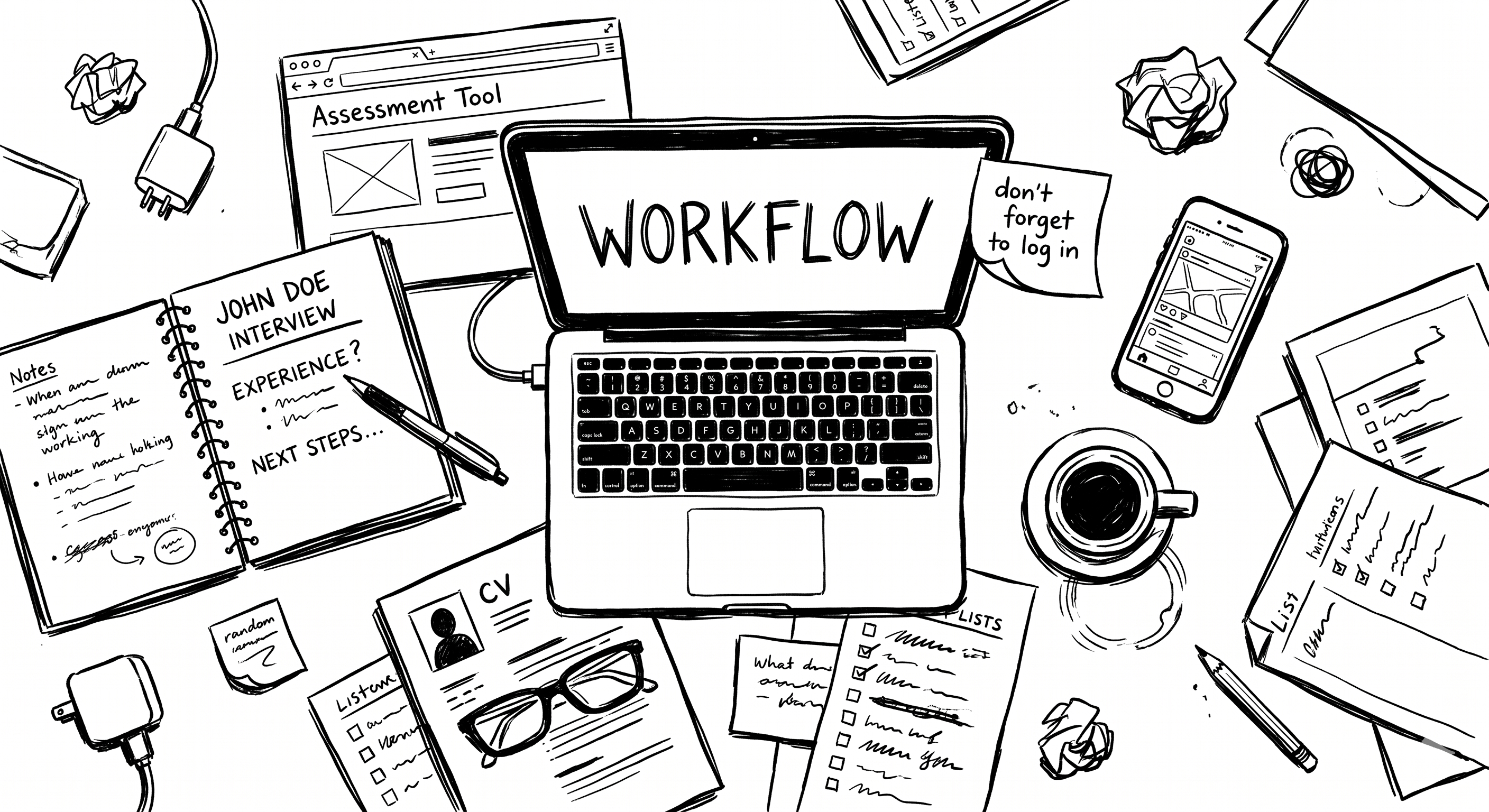
A recruiter shortlists a strong candidate. Everything is going well. The profile is in the HRMS, the notes are there, the decision is made. Then comes the next step — send an assessment. And just like that, the workflow stops.
Not because the assessment tool is bad. Not because the recruiter doesn't know what to do. But because the assessment tool is somewhere else. Another tab. Another login. Another place to find the candidate, re-enter the details, send the link, come back, and manually note that it was done.
The decision happened in one place. The work happened in five.
Where Every Workflow Has a Hidden Edge
Every HR platform has a point where it ends and the rest of the world begins.
Inside that boundary, things work well. Candidate profiles are tracked. Onboarding tasks are assigned. Performance cycles are managed. The data is there. The process is there. The team lives there.
But the moment a workflow requires something the platform doesn't natively offer — an assessment, a background check, a document signing tool, a learning assignment — the user is handed off. Sent to another system. Asked to log in somewhere else and carry their context with them manually.
That boundary is where HR workflows break. Not dramatically. Not with an error message. Just quietly, with a tab.
Most organizations have accumulated six or more disconnected hiring tools alone — resume screeners, assessment platforms, scheduling tools, compliance checkers — each doing its job well, each sitting outside the primary workflow. The silent cost of stitching them together manually runs to nearly 40 hours a month in coordination work that shouldn't exist.
The Problem Isn't the Tool. It's the Distance.
Here's what makes this hard to fix: the tools are usually fine.
The assessment platform works. The background verification system is accurate. The e-signature tool does exactly what it's supposed to do. Nobody is arguing that these capabilities should disappear.
The problem is the distance between where a decision gets made and where the action to execute that decision has to happen.
When a recruiter opens a candidate's profile, they have everything they need to make a judgment. The resume, the interview notes, the hiring manager's feedback — it's all there. But the moment they decide to send an assessment, they leave all of that context behind. They open a new tab. They find the candidate again. They configure the test. They send it. They come back and make a note.
That journey — from decision to action — should take one click. Instead it takes ten minutes across three systems. And those ten minutes happen dozens of times a day, across every person in the team, across every stage of every process.
The tool isn't the bottleneck. The distance is.
What It Looks Like When the Distance Disappears
The shift isn't about replacing specialist tools. It's about relocating them.
When an assessment widget is embedded inside the recruitment module of an HRMS — not linked to, not integrated via a nightly sync, but actually present inside the candidate's profile — the workflow stops breaking at that point. The recruiter shortlists the candidate, sees the assessment widget in the same view, selects the test, and sends it. The status updates in the same place. The result comes back to the same screen.
The assessment tool still does what it does. The recruiter still controls what gets sent. But the action happens where the decision was made, without requiring anyone to leave, re-enter context, or remember to come back.
The same principle applies everywhere the workflow currently hands off. Background checks triggered from inside the onboarding module. Learning assignments sent from inside the performance review. Offer letters generated and signed without leaving the candidate pipeline. Every one of those hand-off points is a place where the process currently breaks — and a place where embedding the right capability would close the gap.
The Architecture Question Behind the Experience
For HR teams, this is a workflow problem. For platform builders, it's an architecture question.
An HRMS that exposes its modules to embedded extensions — widgets, contextual tools, in-workflow actions — becomes something more than a system of record. It becomes the operating layer for the entire employee journey, where specialist capabilities plug in at the exact moment they're needed rather than sitting outside, waiting to be opened in another tab.
This is what extensibility actually means in practice. Not an API that syncs data every hour. Not a marketplace of integrations that require IT to configure. But a platform that lets the right tool appear in the right place, inside the flow where the work is already happening, connected to the account and context the user already has.
HR workflows don't break because of bad software. They break at the boundary between systems — the exact moment the work requires something that isn't already where the decision is being made.
Move the boundary. The workflow holds.
Where does your most important HR workflow hand someone off to another tool — and what would it look like if that handoff didn't exist?


