
The Hidden Cost of Switching Between Systems at Work
Written by Repute Network, Jun 4, 2026 · 4 min read
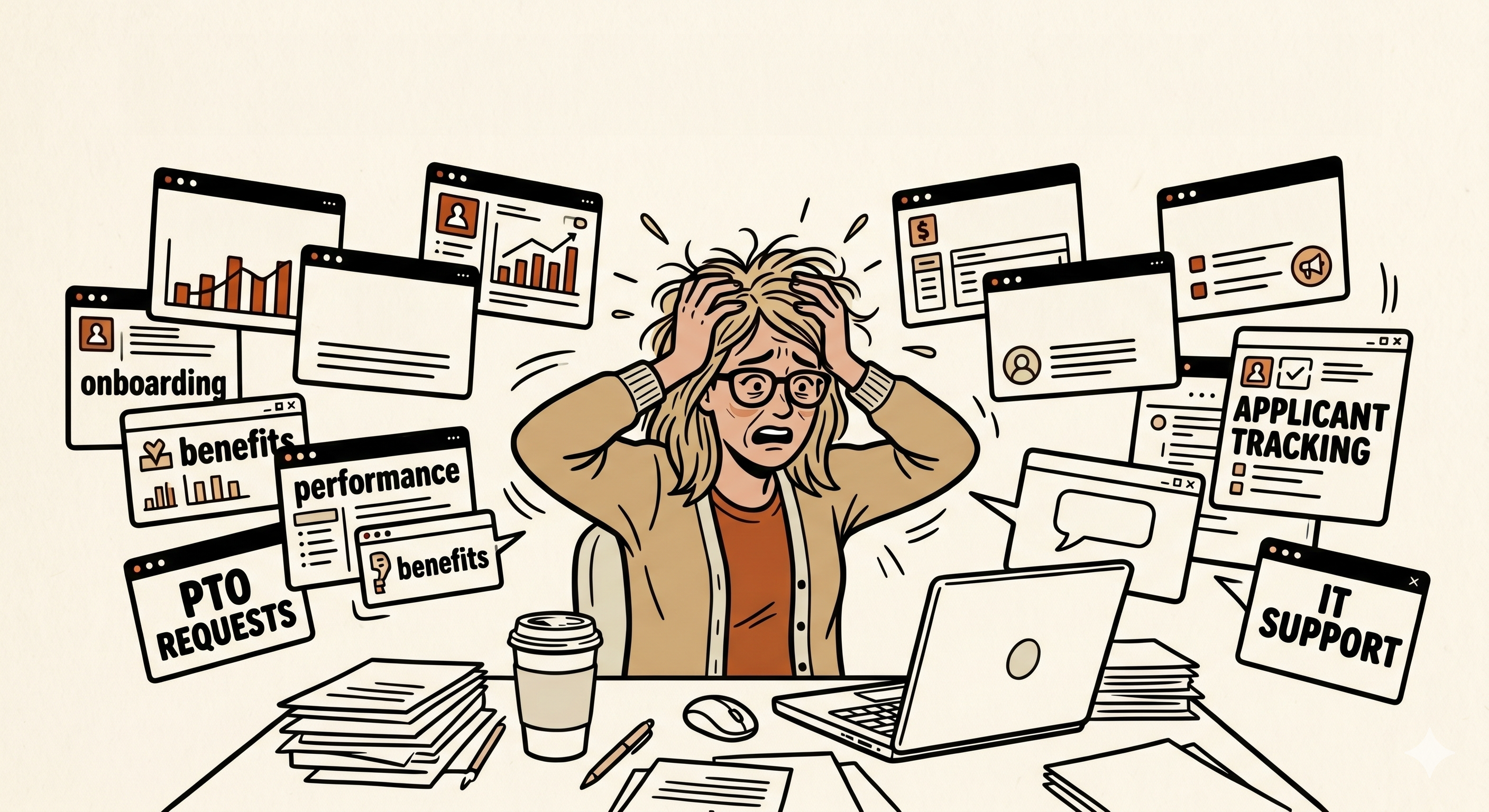
Nobody calls it a problem. It's just how work works.
You need to update an employee's details. That's three systems. You need to check someone's leave balance before approving a request. Two tabs, one manual check. You need to pull together a report on headcount. Four exports, one spreadsheet, two hours. None of it feels broken. It just feels like work. That's exactly why it's so expensive.
The Tab Nobody Counts
The average employee switches between nine different apps in a single workday. Not nine apps total — nine apps per day, constantly, in rotation.
Each switch feels trivial. A few seconds here. A quick log-in there. But the brain doesn't work that way. Research from UC Irvine found that after a significant interruption, it takes an average of 23 minutes to fully return to the original task. Not because people are distracted — because rebuilding context takes time. Every switch resets the clock.
The result isn't lost seconds. It's lost mornings.
For HR and operations teams, this is especially brutal. Their work is almost entirely cross-system by nature. An onboarding task that should take fifteen minutes stretches across four platforms before it's done. A payroll query bounces between HR, finance, and IT before anyone has an answer. A manager trying to understand their team's performance has to stitch together data from three different tools before they can form a single coherent view.
Nobody designed it this way. It just accumulated, one system at a time.
The Invisible Productivity Tax
Here's what makes this cost so hard to see: it doesn't show up anywhere.
It's not on the software invoice. It's not in the HR budget. It doesn't appear in any quarterly review. It lives in the gap between what work takes and what work should take — and that gap is enormous.
22% of workers report losing more than two hours every week to tool fatigue alone. That's 2.5 full work weeks per year, per person, gone. Not to hard problems or complex decisions — to the friction of switching between systems that don't talk to each other.
Scale that across a team of fifty people and it becomes a staggering number. Scale it across an organization, and it's not a productivity issue anymore. It's a structural one.
And it's not just time. Every switch is also a decision made with partial context. A manager approving something without the full picture because the full picture lives in a system they don't have easy access to. An HR business partner giving advice based on data that's three days out of sync. A finance team running numbers on headcount that don't match what HR sees.
Fragmented systems don't just slow people down. They quietly degrade the quality of decisions made across the entire organization.
The Cost Nobody Assigned to Anyone
Here's the uncomfortable part.
Most organizations know this is happening. Ask anyone who works in HR ops, IT, or finance and they'll describe it immediately — the workarounds, the spreadsheets, the manual reconciliations, the "just check both systems to be sure" culture that has quietly become standard operating procedure.
But nobody owns the cost.
It doesn't sit in one department's budget. It's distributed invisibly across everyone's day, which means no single person is accountable for fixing it, and no single metric captures how bad it's gotten.
That's how a problem this visible stays unsolved for this long.
The organizations that start to address it don't do so by buying another tool. They do it by treating the connections between existing tools as the actual work — mapping where handoffs happen, where data moves manually, where switching is inevitable because no integration exists. Then systematically closing those gaps.
It's less exciting than launching a new platform. But it's where the real cost lives.
The Question Worth Asking
The systems aren't the problem. The gaps between them are.
Every minute an employee spends switching context is a minute they're not doing the work the system was supposed to help them do. Every manual handoff is a place where time disappears and errors quietly enter. Every disconnected platform is a tax on attention — paid daily, by everyone, without anyone ever signing off on it.
The tab nobody counts is costing more than most organizations realize.
If you added up every hour your team spent moving between systems last month, what would that number look like — and would it change how you think about your tech stack?


